Question: When should brake discs be replaced?
Answer: While we often pay close attention to brake pad wear, the thickness of brake discs is frequently overlooked. Many people mistakenly believe that brake discs do not wear out. In reality, the same factors that cause brake pads to wear down will also gradually wear down the brake discs over time.
Brake discs have a minimum thickness limit. If this limit is exceeded, braking performance may be compromised.
Question: What are the consequences of using excessively worn brake discs?
Answer: Reduced thickness impairs the brake disc's heat dissipation capacity and mechanical resistance, leading to a range of issues and abnormal braking conditions, including:
Heat cracks: Elevated temperatures and reduced thickness can cause heat cracks to form on the braking surface.
Warpage and vibration: Worn brake discs may warp, causing vibration and noise.
Increased pedal travel: Reduced thickness can lead to increased brake pedal travel. In extreme cases, this can result in brake caliper piston seal failure, brake pad detachment, or seizure.
Question: How do I measure the minimum thickness of a brake disc?
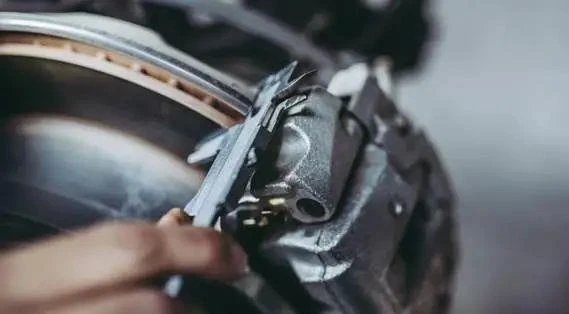
Answer: To accurately measure the minimum thickness of a brake disc, you'll need a caliper and should take measurements at at least four different points. The lowest value obtained should be used as the reference for the entire disc.
Compare this value to the "MIN TH=" marking on the disc, which indicates the minimum thickness in millimeters. If your measurement is below this value, the disc should be replaced.
It's important to note that even if only one brake disc is below the minimum thickness, both discs should be replaced.
Question: What's the solution?
Answer: To ensure the safety of both the driver and passengers, regular inspections of the entire braking system are essential. Any faulty components should be replaced during each inspection.
As a general rule, it's advisable to replace brake discs every two brake pad replacements.