

Shandong Best Auto Parts Co., Ltd. is a brake pad manufacturer located in Shandong, China. The factory was established in 2015. We focus on the production of car brake pads, brake shoes and truck brake pads, brake lining.
As an OEM brake pad and brake shoe manufacturer and supplier, we currently have more than 3,000 models of production molds and maintain more than 2,000 models in stock, we have been committed to providing high-quality and reliable products. Our formulas are asbestos-free, dust-free, noise-free, and have long service life, and are trusted by customers. At the same time, we are also actively exploring the market. Our team is full of professional knowledge and experience, and we will provide high-quality after-sales service and will do our best to meet customer needs.
Why choose us?
Cover more models
We offer an extensive range of ceramic brake pads tailored to fit all models of Japanese, Korean, German, and American cars, providing our customers with a broad selection for any vehicle.
Small MOQ
Our minimum order quantity is only 1 set, providing you with great flexibility to meet your diverse needs for brake pads.
Quality assurance
A full set of quality testing equipment will allow us to repeatedly test and obtain data after production is completed to check product quality.
Fast delivery
We understand that fast shipping is very important to customers, so the models we have in stock only take 3 days.
Supply chain
Establish an integrated supply chain, production chain, and transportation chain. The best solution will be provided by Shandong Best Auto Parts.
Aftersales service
Act quickly on customer feedback to resolve any issues you may have after your purchase.
-
![Auto Ceramic Brake Pads]() Auto Ceramic Brake PadsBrake Pad Set 04465-42140. Location:Front Axle. Brake System:Advics. Width:146.3 mm. Height:56.8 mm. Thickness:17.6 mm.read more
Auto Ceramic Brake PadsBrake Pad Set 04465-42140. Location:Front Axle. Brake System:Advics. Width:146.3 mm. Height:56.8 mm. Thickness:17.6 mm.read more -
![Carbon Fiber Ceramic Brake Pads]() Carbon Fiber Ceramic Brake PadsRake Pad Set 34 21 6 768 471. Location: Rear Axle. Brake System: ATE. Width: 139.7 mm. Height: 67.9 mm. Thickness: 17.3 mm.read more
Carbon Fiber Ceramic Brake PadsRake Pad Set 34 21 6 768 471. Location: Rear Axle. Brake System: ATE. Width: 139.7 mm. Height: 67.9 mm. Thickness: 17.3 mm.read more -
![Carbon Metallic Disc Brake Pads]() Carbon Metallic Disc Brake PadsBrake Pad Set 000 420 59 00. Location: Rear Axle. Width: 122.4 mm. Height: 70.6 mm. Height 1: 64.5 mm. Thickness: 15.2 mm.read more
Carbon Metallic Disc Brake PadsBrake Pad Set 000 420 59 00. Location: Rear Axle. Width: 122.4 mm. Height: 70.6 mm. Height 1: 64.5 mm. Thickness: 15.2 mm.read more -
![Light Vehicle Brake Pads]() Light Vehicle Brake PadsBrake Pad Set :58101-1FE00. Location:Front Axle. Brake System:Mando. Width:131.5 mm. Height:60.1 mm. Thickness:17.5 mm.read more
Light Vehicle Brake PadsBrake Pad Set :58101-1FE00. Location:Front Axle. Brake System:Mando. Width:131.5 mm. Height:60.1 mm. Thickness:17.5 mm.read more -
![Low Dust Brake Pads]() Low Dust Brake PadsBrake Pad Set 43022-S9A-010Location:Rear AxleBrake System:AKBWidth:88.8 mmHeight:47.6 mmThickness:15.3 mmread more
Low Dust Brake PadsBrake Pad Set 43022-S9A-010Location:Rear AxleBrake System:AKBWidth:88.8 mmHeight:47.6 mmThickness:15.3 mmread more -
![Sinter Brakes]() Sinter BrakesBrake Pad Set 04465-20540Location:Front AxleBrake System:AKBWidth:118 mmHeight:58.6 mmThickness:17.5 mmread more
Sinter BrakesBrake Pad Set 04465-20540Location:Front AxleBrake System:AKBWidth:118 mmHeight:58.6 mmThickness:17.5 mmread more -
![Sintered Brake Pads]() Sintered Brake PadsBrake Pad Set 41060-5Y790Location:Front AxleBrake System:TKOWidth:137.2 mmHeight:53 mmThickness:17 mmread more
Sintered Brake PadsBrake Pad Set 41060-5Y790Location:Front AxleBrake System:TKOWidth:137.2 mmHeight:53 mmThickness:17 mmread more -
![Sintered Pads]() Sintered PadsBrake Pad Set 45022-S7A-N00Location:Front AxleBrake System:SUMWidth:148.8 mmHeight:59.4 mmThickness:16 mmread more
Sintered PadsBrake Pad Set 45022-S7A-N00Location:Front AxleBrake System:SUMWidth:148.8 mmHeight:59.4 mmThickness:16 mmread more -
![Thin Brake Pads]() Thin Brake PadsBrake Pad Set 04466-60060Location:Rear AxleBrake System:SUMWidth:116.2 mmHeight:44 mmThickness:15.4 mmread more
Thin Brake PadsBrake Pad Set 04466-60060Location:Rear AxleBrake System:SUMWidth:116.2 mmHeight:44 mmThickness:15.4 mmread more -
![Top Brake Pads]() Top Brake PadsBrake Pad Set 43022-TR0-A00Location:Rear AxleBrake System:AKBWidth:88.8 mmHeight:47 mmThickness:15 mmread more
Top Brake PadsBrake Pad Set 43022-TR0-A00Location:Rear AxleBrake System:AKBWidth:88.8 mmHeight:47 mmThickness:15 mmread more -
![Vehicle Brake Pads]() Vehicle Brake PadsBrake Pad Set 43022ST3E00Location:Rear AxleBrake System:AKBWidth:89 mmHeight:35 mmThickness:12.8 mmread more
Vehicle Brake PadsBrake Pad Set 43022ST3E00Location:Rear AxleBrake System:AKBWidth:89 mmHeight:35 mmThickness:12.8 mmread more -
![Semi-metallic Ceramic Brake Pads]() Semi-metallic Ceramic Brake PadsBrake Pad Set 6C112M008ACLocation:Rear AxleBrake System:BOSWidth:122.8 mmHeight:53.9 mmThickness:17.3 mmread more
Semi-metallic Ceramic Brake PadsBrake Pad Set 6C112M008ACLocation:Rear AxleBrake System:BOSWidth:122.8 mmHeight:53.9 mmThickness:17.3 mmread more


Brake pads are a component of disc brakes used in automotive and other applications. Brake pads are composed of steel backing plates with friction material bound to the surface that faces the disc brake rotors.
Benefits of Car Brake Pads
Enhanced stopping power
One of the primary advantages of car brake pads is their increased stopping power. The materials used in these pads provide a higher coefficient of friction than standard pads, which means they can stop your vehicle more quickly and efficiently, even under extreme driving conditions.
Reduced brake fade
Brake fade is a decrease in stopping power that can occur after repeated or prolonged use of your brakes. Car brake pads are designed to resist brake fade, thanks to their superior heat dissipation properties. This means you can rely on consistent braking performance, even during intense driving sessions.
Increased lifespan
Due to their robust construction and materials, car brake pads tend to last longer than standard brake pads. While they may cost more upfront, the extended lifespan can make them a more cost-effective choice in the long run.
Semi-metallic
Perhaps the most commonly found brake pads, semi-metallic models consist of between 30% and 65% metal. Additional material could include steel wool, wire and copper among others.
Once settled upon these elements are bound together by organic resin. From here they are moulded into pre-set shapes and baked into a furnace, resulting in greater durability.
That robustness is one of their many benefits. Semi-Metallic pads are resistant to heat and far easier on rotors than their Ceramic equivalent. They tend to be cheaper and – when around 60% metal is present – lend themselves to heavy braking over a long stretch of road or track.
Indeed Semi-Metallic brake pads are perhaps best suited to high performance race cars. If you own a vehicle that does 0-60mph in a flash this is the option for you.
Ceramic
By far and away the dearest option, you are likely to own a supercar if possessing a set of ceramic pads. Why the cost? In truth they make for excellent braking, absorbing heat generated from even the harshest, sharpest stops.
Composed of ceramic fibres and similar type fill materials, these pads are cleaner and quieter than any others featured in this blog. They last longer too, outperforming organic pads in particular.
A major drawback is just how long it takes to warm them up to an operating temperature. So while ceramic pads are ideal for rallying, they are all but pointless when installed in the average car, which would seldom reach the optimum performance heat on the likes of the school run or weekly shop.
Low-metallic nao
Better breaking is realised with the Low-Metallic NAO option, the result of an organic formula mixed with between 10% and 30% copper or steel. This recipe certainly helps with the transfer of heat. They are however on the noisy side, while the added metal can create plenty in the way of dust.
Non-asbestos organic
As the name suggests these brake pads are made from largely organic materials. That wasn’t always the case. Indeed there was a time when pads were constructed from asbestos, only for the mineral to be displaced by other compounds amid health and safety concerns.
Softer and relatively quiet, newer versions may include fibre glass, rubber or Kevlar, not to mention resins such as cellulose.
Despite being easier on the brake discs themselves, Non-Asbestos Organic pads will wear fast and are only suitable for day-to-day road driving. What’s more they do not lend themselves to regular braking.
Gather tools, materials
The first thing you’ll want to do is make sure you have your tools and new brake pads handy. As far as tools, you’ll want to round up a jack and jack stands, a lug wrench, C-clamp or caliper spreader tool, and a basic tool set. Many calipers require a Torx or Allen bit to remove the caliper bolts, so check to make sure that you have the correct tool before beginning the job. In addition to your new brake pads, consider picking up a can of brake fluid in case the tank needs to be topped off after you’re done. Be sure to refer to your vehicle owner’s manual so that you select the right type of brake fluid.
Remove the tire
Start by loosening the lug nuts on one of your front-side wheels, and then jack the car up. Slide a jack stand under the frame to support the vehicle, and then fully loosen and remove the lug nuts so that you can take the tire off. Once you remove the tire, you should see and have access to the brake assembly. Most vehicles have a sliding caliper assembly, which is the type of assembly that this step-by-step overview is based on. Additionally, it’s best to do one wheel at a time and not try to change brake pads simultaneously.
Take out the slider bolts, then lift the caliper
You should see two bolts that are working to hold the caliper in place.
Once you’ve removed both bolts, you can remove the caliper completely — just be sure that you don’t disconnect any of the lines. Once the caliper is out of the way, you’ll be able to see the brake pads. If the friction is one-eighth of an inch or less at any part of the pad, then it needs to be changed.
Remove the old pads, clips
Slide the old brake pads out and then remove the abutment hardware. Many new brake pads come with new abutment hardware, but if your pads do not, the old hardware should be cleaned and inspected thoroughly. The new abutment should easily snap into place in the same spot where you removed the old ones. It might help to snap a picture of how your old brake pads were installed to refer back to when you’re determining hardware position so you can ensure they match properly.


Address the pistons
Before the brake pads can be installed, you’ll need to squeeze the pistons back into the caliper. This needs to be done before lowering the calipers into place so that they’re adequately able to clear the thicker, new pads that have been installed. Many vehicles have just one piston per caliper, but if the calipers have two it’s important to push both back at once. You can use a C-clamp to perform this on simple single piston calipers, but it is best to use a caliper piston tool which can be purchased or rented from most auto parts stores. It’s important to apply pressure and be patient, as the pistons tend to retract slowly.
Keep an eye on your brake fluid
Retracting the pistons often causes the level in the brake fluid to increase. You’ll want to keep watch on the brake fluid reservoir and remove some fluid if levels look they might get too high. Be sure to check the fluid during the step where you push the pistons back.
Install your new brake pads
A small amount of disc brake lubricant should be applied between the pads and abutment hardware, and anywhere else there is metal to metal contact between the pad and caliper, being careful not to get grease on the friction surface of the pad or rotor. The pads can now be installed into the caliper.
Slide the caliper back into place, put the wheel back on
Once the brake pads are installed in the caliper, the caliper can be replaced in its normal position on the vehicle. Next, replace the slider bolts. And finally, you’ll conclude the changing of the brake pads by putting the wheel back onto the vehicle. Repeat Steps 1-8 on the other front side of your vehicle to change the other brake pad.
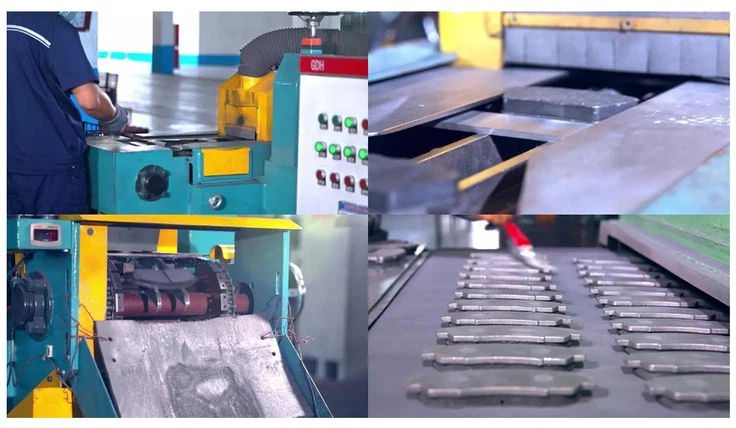
Mixing of raw materials: Brake pads are basically composed of steel fibre, mineral wool, graphite, wear-resistant agent, resin and other chemicals. The coefficient of friction, wear-resistant index and noise value are adjusted by the proportional distribution of these raw materials.
Thermoforming stage: The mixed mass is poured into the mould and then pressed from scratch.
Iron sheet treatment: According to different types of iron sheet cutting, but also after the bead impact appearance hardening treatment, to glue ready to stick on the brake pad prototype.
Hot pressing stage: Using a mechanical iron and brake pads high heat pressure, so that the combination of the two more tightly, the finished product is called brake pads embryo.
Heat treatment stage: In order to make the brake pad material more stable and heat-resistant, it needs to be heated by this heat treatment machine for more than 6 hours for the brake pad blank, and then further processed.
Grinding and cutting stage: After heat treatment, the appearance of brake pads still needs rough edges, so it needs to be grinded and cut to make it smooth.
Paint spraying stage: In order to prevent rust and reach a beautiful effect, it needs to be sprayed with paint.
After baking paint: Warning device or bracket can be processed on the brake pads, ready for packing.
How to Maintain Car Brake Pads
Speed is the enemy
When it comes to braking, full and complete stops from a high speed are absolutely the #1 cause of premature brake pad wear. Speed causes wear on brake pads exponentially – that is, coming to a full stop from 105 kph rather than 85 kph forces the brakes to dissipate 33% more energy.
Brake pads work by transforming energy into heat – and this means they become worn out more quickly the more energy they have to dissipate. If you slow down just a little bit, you can save quite a bit of wear and tear on your brake pads.
Never “two-foot”Your pedals
This is Driver’s Ed 101 – but you should avoid “two-footing” your pedals. If you tend to tap your brake pedal with your left foot while still keeping your right foot on the accelerator, this is a bad habit. It leads to more “brake taps” which don’t’ really do anything to stop your car, and cause premature wear.
Coast more you can
Consider paying more attention to the flow of traffic, and stopped or slowed-down cars that are ahead of you, and coast whenever you can to lower your speed – as opposed to braking.
Going uphill is a great example of this. If you’re driving uphill towards stopped cars, why bother braking before you crest the hill? Simply coast up, and lose some speed, then brake when you really need to.
Or, if you’re going on a freeway off-ramp, just coast from 120 kph to 80 kph, and then press the brakes to slow down the rest of the way. Doing so will seriously extend the lifetime of your brake pads.
Don’t “hurry up to stop”
This advice will help you save on gas, as well as on brake wear and tear. Is there a red light or a stop sign coming up? Start coasting and slowing down!
There is absolutely no reason to step on the gas and “hurry up to stop” when the cars ahead of you are clearly not moving. All you’ll do is waste fuel – and when you do have to stop, you’ll put excessive wear and tear on your brake pads.
Keep your car as light as possible
Most people don’t keep heavy objects in their car, but if you tend to keep a lot of stuff in your car, that weight can add up – and lead to a larger kinetic load that your brake pads must halt when you stop.
This doesn’t just apply to objects in your car, either. Aftermarket stereo systems, body panels, wheels, and other customizations can make your car much heavier – resulting in shorter brake pad life.
Flush your brakes every 2 years
Your brakes should be bled and flushed about every 2 years, especially if you have an older car. This will help your brakes work more effectively, and make your internal components work longer.
This is because brake fluid naturally attracts water. During emergency braking or repeated brake use, this moisture can “boil”, reducing braking effectiveness. Moisture can also cause internal corrosion, reducing the lifespan of brake components like rubber seals.
How to Choose the Right Car Brake Pads
Material
The type of material a brake pad is made from will determine its performance and longevity. Ceramic, metallic, and semi-metallic pads all provide different levels of braking power and noise reduction depending on the situation. It’s important to consider how often you use your brakes and what type of environment they are in when making this decision.
Fit
Different brake pads come in different sizes and are specifically designed to fit certain makes and models of vehicles. Be sure to measure the brake pad’s dimensions before purchase to ensure a proper fit for your vehicle.
Durability
The durability of a brake pad depends largely on its material, but it is also important to consider the manufacturer as well. Check reviews and ratings online before making your purchase to get a better idea of how long a particular brake pad is expected to last.
Price
Brake pads can range anywhere from a few dollars per set up to hundreds depending on the type and manufacturer. Be sure to compare prices between different brands to find the best deal for your budget.
Our Factory
Shandong Best Auto Parts Co., Ltd. is a brake pad manufacturer located in Shandong, China. The factory was established in 2015. We focus on the production of car brake pads, brake shoes and truck brake pads, brake lining. As an OEM brake pad and brake shoe manufacturer and supplier, we currently have more than 3,000 models of production molds and maintain more than 2,000 models in stock, we have been committed to providing high-quality and reliable products. Our formulas are asbestos-free, dust-free, noise-free, and have long service life, and are trusted by customers. At the same time, we are also actively exploring the market. Our team is full of professional knowledge and experience, and we will provide high-quality after-sales service and will do our best to meet customer needs.


FAQ
We're well-known as one of the leading car brake pads manufacturers and suppliers in China. Please rest assured to buy cheap car brake pads for sale here from our factory. For price consultation, contact us.
highly recommended brake pads, global brake pads, chinese brake pads